My aunt said, “You know your grandmother is the only one who remembers who that man is,” and held up a photo from a shoebox like she was presenting evidence in court.
It was a black-and-white picture of a man standing beside a truck, one hand on the hood, squinting like he’d been interrupted. None of us knew his name. My grandmother did, but she had to sit with it for a minute. She tapped the corner of the photo and said, “That’s Junior, but not our Junior. That’s Elsie’s Junior. He drank too much.”
That was the sentence that started the whole thing, basically.
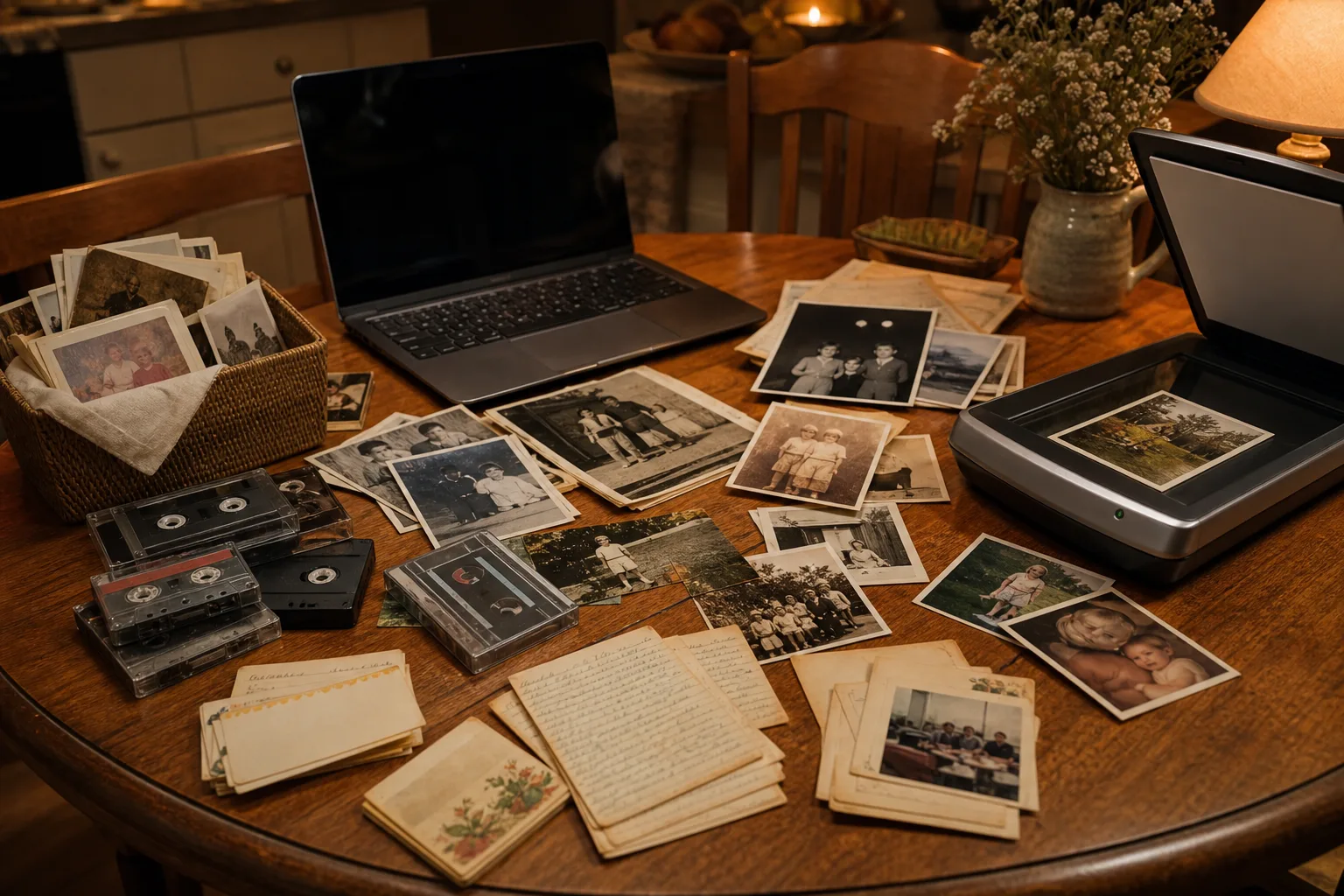
We had been talking for months about “doing something” with the family stuff. Everybody has a version of this: boxes of photos, envelopes full of obituaries, birth certificates folded into plastic sleeves, recipes written on index cards, cassette tapes nobody can play, and one person in the family who somehow knows how all the names connect. In our case it was mostly my grandmother and, after her, my aunt Linda. The problem was that both of them were tired of being the human search engine.
So I volunteered, maybe too confidently, to build a searchable family memory system. I said it like I knew what that meant. Scan everything, record stories, upload transcripts, tag people, places, dates. Use AI to search across it and maybe spot patterns we kept circling without naming. Migration, marriages, illnesses, the way certain jobs ran through one branch, the way nobody talked about one side of the family after 1978.
The first Saturday, I brought a scanner to my mom’s kitchen table. I had a laptop, a phone tripod, a pile of folders, and the smug energy of someone who had watched two tutorials. Within an hour, the scanner jammed on a funeral program, my mom was annoyed that I was taking photos out of albums, and my grandmother kept saying, “Don’t put that in there,” without explaining what that was.
The AI part was both useful and weird almost immediately. I fed it a transcript from a voice memo where my grandmother talked about growing up near the river, and it pulled out names I had missed because she said them so casually. It connected “Miss Netta” in one story to “Nettie Mae” in an obituary. That felt like magic for about ten minutes.
Then it confidently told me two cousins were the same person because they had similar names and were born in the same county. They were not. One of them had died as a baby. The other had lived into her nineties and scared everyone at Thanksgiving. That was the first time I wrote, in all caps in my notes, AI IS NOT THE FAMILY ELDER.
The transcripts were messy too. My uncle’s name, Ray, became “rain” over and over. “Aunt Bee” became “happy.” A whole story about someone losing a farm got turned into something about “form loss,” which sounded like a software error instead of a family wound. I spent more time correcting the machine than I expected. The work was not graceful. It was sitting there at 11:40 p.m. changing “Mable” back to “Mabel” for the fiftieth time while wondering if any of this would make sense to anyone later.
The harder part was not technical. It was deciding what counted as preservation and what counted as dragging things back into the room.
There were stories about drinking, affairs, estrangements, children raised by people who were not their parents, money borrowed and never returned. Some of it explained a lot. Some of it felt like gossip wearing a historical costume. My cousin wanted everything included because “that’s the truth.” My mom wanted some things sealed until certain people were gone. My grandmother would sometimes tell a story in full and then, once I stopped recording, add the sentence that made the story make sense.
I didn’t know what to do with that.
At one point I made a private tag called “repeated patterns,” and I felt ridiculous and nosy while doing it. But the patterns were there. Women leaving school early to take care of siblings. Men disappearing after a death. People moving north, then sending for cousins one at a time. A line of relatives who worked with their hands until their bodies gave out. Another line where nobody went to the doctor unless something was falling off.
Seeing it all in one place made certain family traits feel less like personality flaws and more like weather systems people had been born into. Not excuses. Just context.
The best moment came from something small. My aunt searched for a street name and found three separate stories tied to the same house: a baby born there, a card game that ended in a fistfight, and a Christmas where someone pawned a watch to buy groceries. She sat back and said, “I knew that house was important, but I didn’t know why.”
That was probably the closest the project came to feeling like it worked.
It is still incomplete. There are duplicate files everywhere. Half the photos are labeled “unknown woman blue dress” or “possible church picnic.” The AI still gets too confident. My family still argues about what should be searchable. I still have a bag of tapes in my closet that I keep meaning to digitize.
But now when my grandmother says, “You remember Elsie’s Junior,” I can at least type in Elsie and see what rises to the surface. Sometimes it’s wrong. Sometimes it’s just enough to keep asking.